Building AI Literacy: From Learners to Frameworks in AIM-PRO
Welcome to the second issue of the AIM-PRO newsletter!
This issue of the AIM-PRO newsletter explores how AI competence develops from the learner’s perspective to framework design. Discover insights from our project partners on training strategies, stakeholder needs and practical tools for educators, trainers and SMEs.
Updates from Vrije Universiteit Brussel (VUB)
AI Competence Starts with You, The Learner
When adults think about learning with AI, they ask questions like “How do I use it?” “Will it truly help me?” “Can I trust it?” and “What might I gain or lose in the process?” These questions show that AI competency is not only about learning to operate a tool but also about confidence, judgement, responsibility and context.
AIM-PRO-related research with adult learners clearly shows this dual view. Adult learners recognise AI’s potential, for example, for rapid access to information, personalised support, instant feedback and content creation. At the same time, they raise concerns about issues such as inaccuracy, over-reliance, privacy, environmental impact and job displacement. This tension is where AI competency training should begin. That’s why AI training should not start with the tool. It should start with the learner.
Winning the Outstanding Poster Award at EdMedia2026
Congratulations to Tian Zhou on winning the ‘Outstanding Poster Award’ at EdMedia2026!
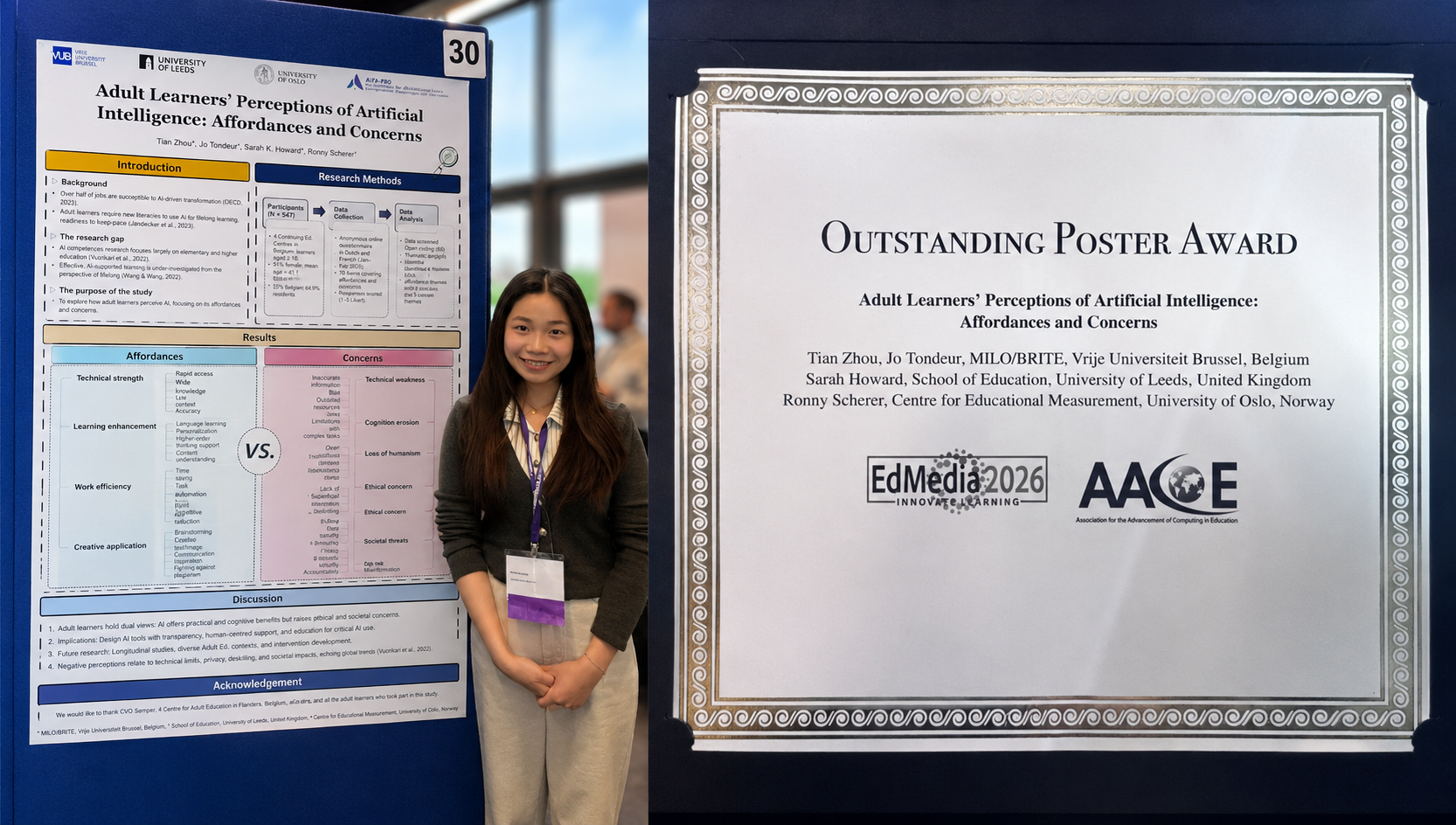
Adult learners are often an overlooked group in AI competency debates. Zhou’s AIM-PRO-related poster, recognised with an Outstanding Poster Award at EdMedia, shows why their perceptions matter: learners see AI as useful, but also raise important questions about trust, responsibility and control.
See the full post on LinkedIn.
From Digital Competence to AI Competence
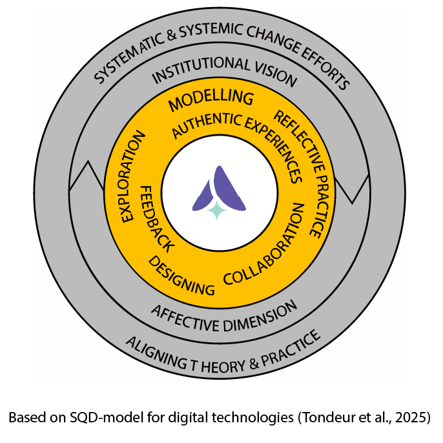
AI competence does not develop through a single method, tool or fixed pathway. Like broader digital competence, it involves the integrated and functional use of knowledge, skills and attitudes. It grows through connected learning experiences: opportunities to explore, reflect, practice, receive feedback, collaborate and build confidence in meaningful contexts.
This is where AIM-PRO draws on SQD2, a research-based framework for developing digital competencies. SQD2 approaches competence development across multiple levels, from the learner and the learning activity to the wider organisational and institutional context. For AIM-PRO, this means that meaningful technology use requires more than technical instruction. Learners need structured opportunities for exploration, reflection, design, authentic practice, feedback and support. The following visual illustrates how these elements come together across different levels, from individual learning activities to wider institutional context:
Generative AI is no ordinary digital tool. It can produce and adapt content, suggest solutions, support design processes and participate in instructional decision-making. This creates new opportunities for learning and teaching. At the same time, generative AI can produce inaccurate, incomplete or biased outputs. It can also make responsibility less clear: when a system suggests an answer, a design choice or a decision, users still need to judge what is appropriate, reliable and ethically acceptable.
This is why AIM-PRO builds on research into Intelligent SQD, or iSQD. Based on a meta-aggregation of qualitative studies, iSQD extends the SQD2 foundation by examining which training strategies become specific, different or more important when the focus shifts from digital competence to AI competence. The following image highlights three iSQD subcategories:
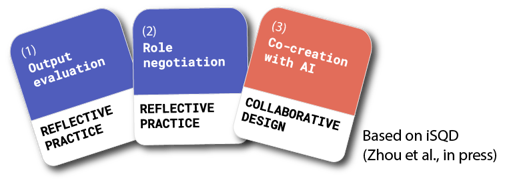
Linked to three real-life examples, this could mean:
- Professionals verifying data reports (output evaluation)
- Trainers maintaining the ‘human touch’ in mentorship (role negotiation)
- SME employees drafting marketing copy or technical reports (co-creation with AI)
Effective Training Strategies Need Real Users
AIM-PRO does not design AI training for an abstract “average user”. The project works across different learning and professional contexts, including higher education, vocational education and training, small and medium-sized enterprises, trainers, students and professionals. These groups may differ strongly in prior knowledge, confidence, motivation, professional responsibility and concerns about AI.
A university lecturer, a VET trainer and an SME employee may all need AI competency, but not necessarily in the same way, at the same pace or for the same purpose. To make these differences visible, AIM-PRO is developing hypothetical personas: conceptual user profiles that help translate research-based training principles into concrete design questions. These personas are not yet validated representations of AIM-PRO users. Instead, they help us make assumptions explicit.
Meet Our Hypothetical Persona Dr. Clara:
Dr. Clara already uses digital tools in teaching but still feels uncertain about how generative AI should be integrated into learning activities. She sees opportunities for faster feedback, content generation, student support and instructional design. At the same time, she worries about academic integrity, the reliability of AI-generated output, student over-reliance, bias, copyright and the changing role of the teacher.
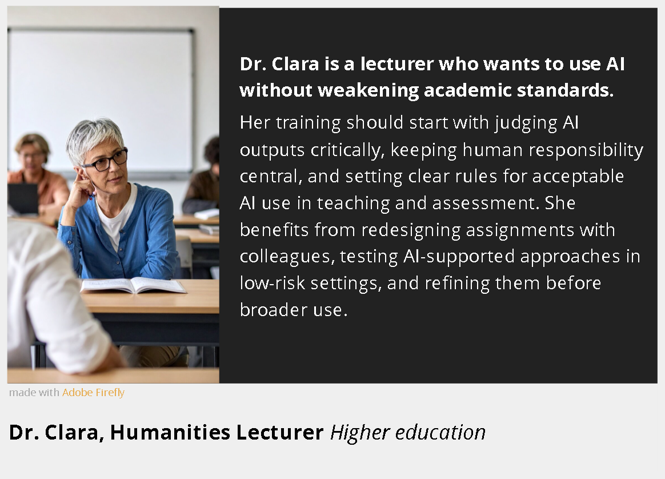
Dr. Clara is one of AIM-PRO’s hypothetical personas representing educators using generative AI in teaching.
Starting from personas, AIM-PRO will investigate real user needs and examine whether training strategies transfer meaningfully across different educational and professional contexts. This validation process will help refine the personas and help ensure that AIM-PRO’s outputs are grounded in both research and practice.
Whether you are a university lecturer redesigning learning activity, a VET trainer seeking new pedagogical strategies, or a professional in an SME looking to use AI responsibly, AIM-PRO is investigating your needs to build technology that fits.
Updates from the University of Pisa (UNIPI)
What Do Educators, Trainers and Business Leaders Really Need from AI Literacy?
The growing impact of AI across education, training and industry highlights the need for AI literacy initiatives that respond to the real needs of learners, educators, trainers and professionals.
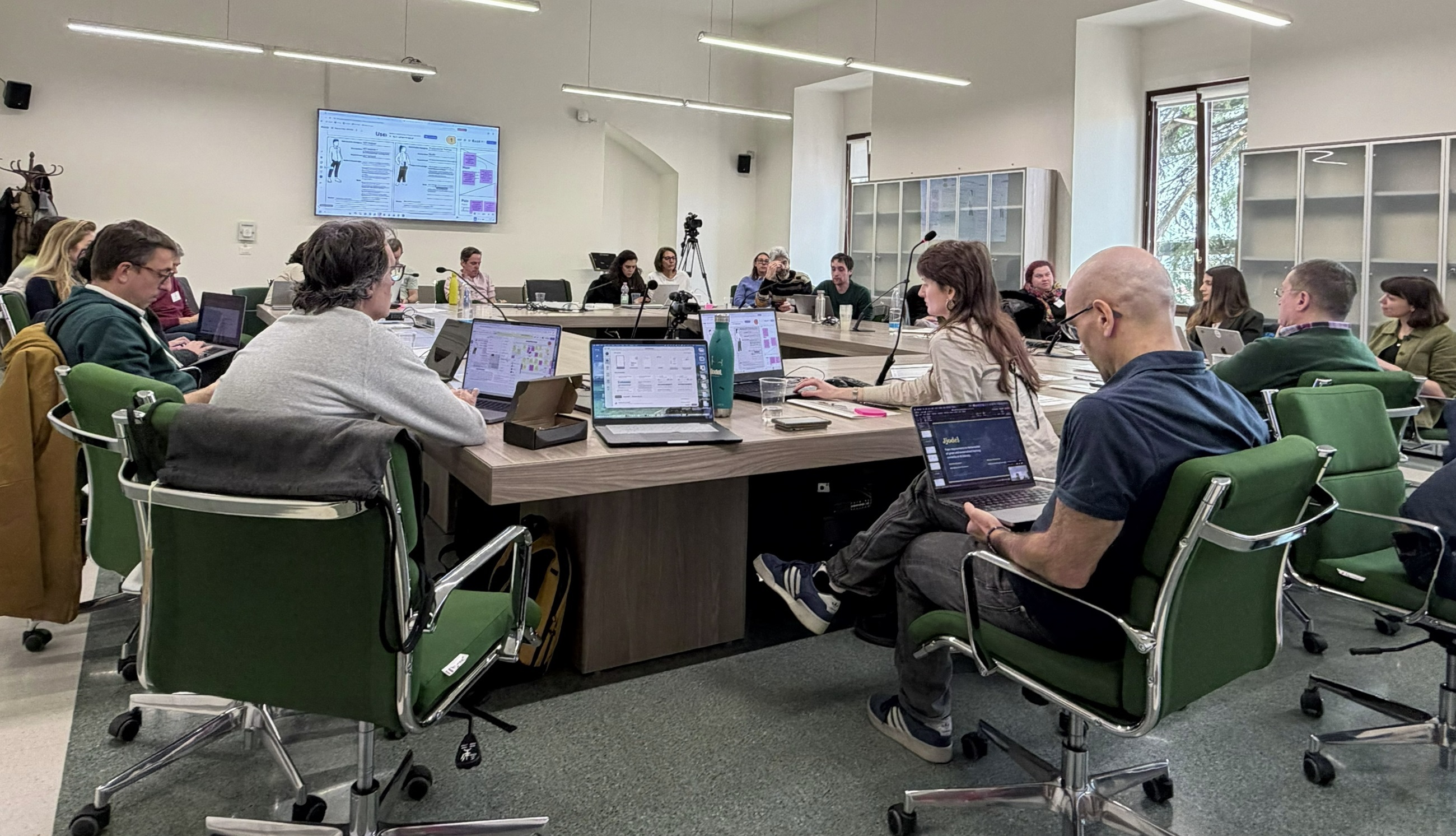
Co-design workshop at AIM-PRO kick-off meeting earlier this year.
Building on data collected during the co-design workshop organised at the AIM-PRO kick-off meeting in L’Aquila (10–11 February 2026), the University of Pisa developed a structured report to consolidate and analyse stakeholder needs related to AI literacy. The workshop employed User Personas and Empathy Maps to explore the perspectives, goals, concerns and expectations of representative profiles from Higher Education (HE), Vocational Education and Training (VET), and Small and Medium Enterprises (SMEs).
The identified needs were subsequently consolidated into a unified dataset through a structured process of manual cleaning, harmonisation and de-duplication. Importantly, AI literacy content itself was intentionally excluded from the analysis, as these areas are already addressed by established frameworks and guidelines. Instead, the focus was placed on identifying design and technical requirements that should guide the development of an AI literacy learning platform. (Ng et al., 2021; UNESCO, 2024).
Emerging Needs: Control, Trust and Practicality
One of the key findings is that stakeholders want to understand AI, not just use it. Across all groups, participants highlighted the need to know what AI can and cannot do, while maintaining control over AI-supported processes. Trust, transparency and clear explanations of AI outputs also emerged as essential requirements for effective and responsible AI use (Ng et al., 2021; UNESCO, 2024).
Flexible and Context-Specific Learning
Stakeholders’ needs vary across contexts: SMEs prioritise flexible training, VET focuses on practical and job-related applications, and Higher Education emphasises critical thinking and academic integrity. However, all groups agree that AI literacy initiatives should be adaptable, practical and relevant to real-world needs.
Ethical, Responsible and Sustainable AI
Another key theme concerns the ethical, responsible and sustainable use of AI. Stakeholders highlighted the importance of transparency, privacy, accountability and compliance with emerging regulations such as the EU Artificial Intelligence Act (European Parliament & Council, 2024). At the same time, growing attention is being paid to the environmental and societal impacts of AI, reinforcing the need for AI literacy initiatives that promote responsible and sustainable adoption (European Commission, 2022; UNESCO, 2024).
Building a Robust and Validated Needs Framework
To validate and enrich the identified needs, dedicated questionnaires have been developed for stakeholders from Higher Education, VET and SMEs. The results contributed to a consolidated needs framework covering key areas such as human agency, trust, usability, personalisation, professional development and infrastructure support, providing a strong foundation for the design of the AIM-PRO AI literacy learning platform.
Community & Ecosystem
Community and ecosystem integration also emerged as an important dimension of AI literacy. Across stakeholder groups, there is a strong interest in opportunities for collaboration, knowledge sharing and participation in professional learning communities. Stakeholders highlighted the value of connecting with peers, experts, higher education institutions and innovation networks to exchange experiences, access new knowledge, and support the effective adoption of AI. These findings suggest that AI literacy initiatives should not only provide learning resources but also foster communities and ecosystems that enable continuous learning and collaboration (OECD, 2021).
Looking Ahead
The work carried out within AIM-PRO demonstrates that AI literacy extends far beyond learning how to operate AI tools. Educators, trainers, students and business professionals need opportunities to develop critical understanding, practical skills, ethical awareness and sustainability-oriented thinking. By addressing these needs, AI literacy initiatives can help ensure that AI is adopted in ways that are effective, responsible, and aligned with both human and societal values.
References
- European Commission (2022). Ethical Guidelines on the Use of Artificial Intelligence (AI) and Data in Teaching and Learning for Educators.
- European Parliament & Council of the European Union (2024). Regulation (EU) 2024/1689 laying down harmonised rules on Artificial Intelligence (Artificial Intelligence Act).
- Ng, D. T. K., Leung, J. K. L., Chu, S. K. W., & Qiao, M. S. (2021). Conceptualizing AI Literacy: An Exploratory Review. Computers and Education: Artificial Intelligence, 2, 100041.
- UNESCO (2024). AI Competency Framework for Students.
Updates from the University of Salamanca (USAL)
Mapping the Conceptual Terrain of AI Literacy
The work at the heart of AIM-PRO’s Task 2.3 has reached the point where the broad shape of the AI literacy competency model is finally visible. The task set out to answer two deceptively simple questions for the consortium: which AI literacy competencies should AIM-PRO target, and how should they be clustered across Higher Education, VET and SMEs? After several rounds of cross-framework analysis and partner discussion, a working answer is now on the table, and a first consolidated version is already feeding into the parallel activities of WP4 and WP5.
The current draft organises AI literacy into four broad competence categories, with roughly twenty-five competencies in each:
- Digital Skills. AI-aware digital basics, including data literacy, critical reading of AI outputs and responsible everyday use.
- Deep Tech Skills. The technical core, covering machine learning, neural networks, NLP, computer vision, algorithm design, and the integration of AI with Model-Driven Engineering and Digital Twin technologies.
- Green Skills. Competencies for the environmental footprint of AI and for green computing practices across the AI lifecycle.
- Resilience and Entrepreneurial Skills. Adaptability, opportunity spotting and responsible innovation in AI-driven environments.
Each competency is described through the Knowledge, Skills and Attitudes (KSA) taxonomy and tagged with one of three proficiency levels (Foundation, Intermediate, Advanced). 17 competencies are currently flagged as relevant across all three educational contexts and will form the AIM-PRO common core.
One conviction has stayed constant throughout developing Models for AI Literacy Competencies (T2.3): AI literacy in AIM-PRO has to be more than a technical syllabus. The metamodel therefore reads competencies along three dimensions that cut across the four categories above:
- a technical dimension, covering how AI systems work and how they are built, evaluated and used in practice;
- an ethical and human-centred dimension, covering fairness, transparency, accountability and the wider societal impact of AI;
- a sustainability dimension, covering the environmental cost of AI and the practices that mitigate it, an area where most existing AI literacy frameworks remain conspicuously thin.
This three-way reading is what allows the same learner profile to be described from a technical, an ethical and an environmental angle at once. It is also what will let WP4 and WP5 attach assessment evidence, OER tagging and certification logic to a single coherent model later in the project.
T2.3 has been built in close dialogue with the European policy ecosystem. The strongest reference point is the EU AI Act, in particular its Article 4 AI literacy requirement, which informs the regulatory-awareness and responsible-use strands of the framework. The work also draws on European competence frameworks (DigComp 2.2, GreenComp, EntreComp), which provide a starting structure for the digital, green and resilience categories. International AI literacy references, including the OECD/EC AILit framework, the UNESCO AI Competency Framework for Students, and the academic work of Long and Magerko, help the team check coverage and keep AIM-PRO comparable at the international level.
Every competency in the catalogue keeps a trace back to its source. The metamodel has been designed so that future updates to EU instruments can be absorbed without structural rework, an important property given how quickly the regulatory landscape is moving.
The coming months will be devoted to refining and validating the framework with the AIM-PRO partners and with EITCI on the certification side. The objective is a stable reference, aligned with EU policy and pedagogically sound, that the rest of the project can build on with confidence. The work is far from finished, but the conceptual terrain of AI literacy in AIM-PRO is, for the first time, on a single map.
Updates from the Mälardalen University (MDU), Fondazione Bruno Kessler (FBK) & University of L’Aquila (UDA)
AI Literacy Support – Domain Analysis Progress
The AIM-PRO project aims to automate the creation and delivery of courses aimed to improve AI literacy. In this newsletter, we report the current progresses we have done in the analysis of the domain and its encoding as metamodels. Metamodels provide the fundamental concepts and relationships through which a certain domain can be represented for a given purpose. In the case of AIM-PRO, the metamodels aim to describe multifaceted concerns related to AI literacy-related learning activities.
In order to explain the domain conceptualisation, we propose a running example/scenario and its corresponding encoding into the metamodels proposed by AIM-PRO.
Learning Scenario: “Elena, the Sceptical HR Director”
Profile: Elena is an HR Director in a traditional Small-to-Medium Enterprise (SME) with a heterogeneous workforce and varying levels of digital competence. While she sees potential value in AI for improving efficiency, she feels uncertain and anxious about fairness, accountability and employee trust. She hears colleagues expressing that the change may be too difficult. Her profile reflects low AI self-efficacy and a cautious attitude, driven more by responsibility concerns than resistance.
AI Literacy Competence Goals: Elena is receiving a lot of job applications and is overwhelmed by the volume. She tested an AI tool for screening resumes, and her managers asked her to train the HR team to use it. However, she is unsure about the tool’s accuracy and fairness, and worries about potential biases in the screening process. Her goal is to understand how the AI tool works, its limitations, and how to ensure it is used ethically and effectively in the hiring process. She wants to be sure that her team understands the tool, questions its outputs, knows when not to use it, and agrees on don’t delegate role to it for moving candidates forward.
First of all, we need to represent contextual information about the scenario that is relevant for AI literacy learning. In the case of Elena, we encode such information as:
| Field | Description | Value |
|---|---|---|
| role | Role in the organisation | HR Director |
| attitude | Attitude towards AI | Cautious |
| self-efficacy | Self-efficacy with AI | Low |
| key concerns | Key concerns about AI use | Fairness, accountability, employee trust, tech gap marginalisation |
| motivations | Motivations for using AI | Improving efficiency, Responsible integration, Duty of care |
| experience | Previous experience with AI tools | Limited hands-on experience with AI tools |
Based on the contextual information, it is possible to derive some overall strategic decisions about potential AI Literacy training, as described in the following.
AI Training Strategy:
- Elena has low AI self-efficacy and confidence, so AI Familiarisation and Affective Support are needed early on to build her confidence and reduce anxiety.
- Elena has limited hands-on experience with AI tools, so building a strong baseline knowledge is essential before moving to practical application.
- Given her concerns about fairness and accountability, it’s important to include training on ethical considerations and bias mitigation strategies.
- The context is Train-the-Trainer in a traditional SME setting (HR Screening), so we are in presence of a high-risk context, where the AI is used for making decisions that can significantly impact people’s lives (hiring), and where the workforce is heterogeneous with varying levels of digital competence. Therefore, a comprehensive training strategy that addresses role boundaries, collaborative sensemaking, and ongoing support is crucial to ensure responsible and effective AI use.
The mentioned decisions are in turn encoded as follows:
| Field | Description | Value |
|---|---|---|
| sector | AIM-Pro Learning Environment (HE, SME, VET) | SME |
| risk | The level of impact of AI use on the organisation, higher for decision-making processes | High |
| competency goals | High-level learning goals | Develop foundational AI literacy, teach responsible AI use to the HR team, address ethical concerns, and create shared rules for AI use in hiring |
| learning mode | Training modality (Train-the-Trainer, individual, team) | Train-the-Trainer |
| agency | Who has the authority to make decisions about AI use? | Shared |
The information about the learning context and the derived strategies for AI literacy learning allow to generate a learning path composed of a number of steps and corresponding goals. These steps are conceptually linked with iSQD (Skills, Qualifications, Development) strategies.
| Step | iSQD Strategy | Description | Goal |
|---|---|---|---|
| 1 | S1 Familiarization | Build AI proficiency by blending structured, scenario-based guidance with progressive open exploration. | Build a shared understanding of the AI tool. |
| 2 | S5 Affective Dimension | AI training must account for the learner's emotional state, attitudes, and self-belief to be effective. | Surface concerns about fairness, trust and job impact. |
| 3 | S2 Reflective Practice | AI training requires critical reflection on the tool's potential and limitations within a professional context. | Define boundaries, responsibilities and responsible-use rules. |
| 4 | S4 Authentic Experiences | AI proficiency requires hands-on practice and feedback to adapt the technology to a user's authentic professional environment. | Elena demonstrates the tool with anonymised examples. |
| 5 | S3 Collaborative Design | Design AI materials through human collaboration and iterative experimentation. | Team jointly interprets outputs and co-creates rules. |
| 6 | S4 Authentic Experiences | Team practises with safe examples. | |
| 7 | S2 Reflective Practice | Team evaluates outcomes and refines the process. |
At the end of the learning path, Elena is expected to have achieved a number of competencies with corresponding proficiencies. A summary of such an outcome is provided in the following:
| Code | Competency | Description | Category | Proficiency Level | Why it is activated |
|---|---|---|---|---|---|
| D01 | AI Concept Understanding | Comprehend what AI is, its types, and how it differs from traditional software | DIGITAL | FOUNDATION | Elena and the team need basic understanding before use. |
| D05 | AI Output Evaluation | Critically assess AI-generated content for accuracy, bias, and reliability | DIGITAL | INTERMEDIATE | They must evaluate AI-generated screening outputs for accuracy, bias and reliability. |
| D07 | AI-Augmented Decision Making | Integrate AI insights with human judgment for informed decisions | DIGITAL | INTERMEDIATE | AI should support, not replace, HR judgement. |
| D08 | Generative AI Literacy | Understand the capabilities and limitations of generative AI models | DIGITAL | INTERMEDIATE | Elena needs to understand AI capabilities and limitations before explaining them. |
| D09 | AI Tools Selection | Identify and select appropriate AI tools for specific tasks | DIGITAL | INTERMEDIATE | The team needs to judge whether the tool is appropriate for screening tasks. |
| D10 | Human-AI Collaboration | Distribute tasks between humans and AI based on respective strengths | DIGITAL | INTERMEDIATE | The team must define what AI does and what humans decide. |
| D11 | Digital Content Co-creation | Collaborate with AI to produce and enhance digital content | DIGITAL | INTERMEDIATE | Elena may need to co-create training materials, prompts, checklists or guidance with colleagues. |
| D16 | Data Privacy in AI Contexts | Apply data protection principles when using AI systems | DIGITAL | FOUNDATION | Candidate data is sensitive and requires careful handling. |
| D23 | AI Workflow Integration | Embed AI tools into professional and educational workflows | DIGITAL | ADVANCED | AI may later be embedded into the HR workflow. |
| R05 | AI Change Management | Lead organisational transitions involving AI adoption | RESILIENCE | ADVANCED | Elena is leading an organisational change process. |
| R19 | Stakeholder Engagement with AI | Communicate AI strategies to diverse stakeholders | RESILIENCE | INTERMEDIATE | She needs to communicate expectations, risks and boundaries. |
| R24 | Community of Practice Building | Foster networks for sharing AI best practices | RESILIENCE | INTERMEDIATE | Sustainable team use requires shared learning and exchange. |
| R27 | Human Agency and Oversight | Maintain meaningful human agency and oversight when AI systems support or automate decisions and actions. | RESILIENCE | ADVANCED | Human authority and accountability must remain explicit. |
******
That’s it for the second issue of our newsletter. Stay updated on our progress, results and upcoming events by visiting our website, subscribing to our quarterly newsletter, and following us on LinkedIn, YouTube and Zenodo.
We’ll be back in October 2026 with the next updates and stories.
AIM-PRO Project - 101245864 | Funded by the European Union
Read more at: https://aim-pro.eu/newsletters/2026-07-newsletter